






“Aunt Ann’s Lucia”: Ann Hoffman Nicholas Was Early Translator of Italy’s Greatest Novel

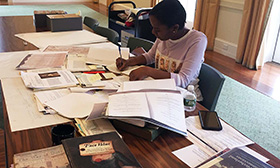
Having grown up in Italy, where Alessandro Manzoni’s historical novel I Promessi Sposi (The Betrothed) is a national literary treasure, I was thrilled to learn about an 1834 English translation “by a lady” whose family papers are preserved at the Historic Hudson Valley Library and Collections. The translation is the object of an enthusiastic review included in a notebook of the Hoffman family collection that I had the opportunity to view during my summer research fellowship at the Women’s History Institute of Historic Hudson Valley.

Ann Hoffman Nicholas (January 22, 1790 – April 17, 1840), the eldest daughter of lawyer and politician Josiah Ogden Hoffman and his first wife Mary Colden, is not new to researchers of these archives. Her life, full of unexpected twists and turns, has been featured before, for example in this article about her training in missionary work at the Hamilton Literary and Theological Seminary. It was toward the end of her stay in Hamilton that Ann wrote a letter that was later inserted as a translator’s note in the American edition of Manzoni’s novel titled Lucia, The Betrothed, published by George Dearborn, New York, in 1834.

In that note, Ann thanked Nathaniel F. Moore, Professor of Greek and Latin at Columbia College, for sending her Manzoni’s Promessi Sposi, and reflected on “the inadequacy of any translation to convey a distinct and correct idea of the author’s genius and design.”1 Despite what she described as the limits of her work, including the omission of sections considered redundant, she expressed gratitude for the opportunity to translate the novel and admiration for the author’s insight into human nature. Ann signed the note simply as “A. N.,” using the initials of her married name, followed by the place of writing and date: Hamilton, October 8th, 1833.2

Ann’s full name never appeared in the 1834 book. This edition of Manzoni’s novel, available online and in academic libraries, is typically cited as anonymous or attributed to biblical scholar and man of letters Andrews Norton. More research is needed to understand how and when this attribution originated, but it can be found online and in academic publications by Italian scholars of Manzoni’s work.3 One possible explanation of the identification of “A.N.” as Andrews Norton is that between 1833 and 1834, he was co-editor of The Select Journal of Foreign Periodical Literature4 and edited at least another Italian work, Silvio Pellico’s memoirs My prisons,5 published in 1836.
In the nineteenth century, publishing (or in this case, translating) anonymously was not unusual for women, both due to an aversion to “personal publicity” and a fear of being “looked on with prejudice.”6 This applied particularly to women of high social status, as Ann had been in her youth, because it often meant that they had fallen on hard times and needed an income or, perhaps slightly better, were free from family and social responsibilities (unmarried). We don’t know the circumstances that led Ann to translate this book, whether she was compensated for it, and if anonymity was her choice or a matter of conventions.
Some of the people around her, however, expressed great pride in her accomplishment and believed that her work was worthy of mention. In addition to the review cited earlier, the 1833 volume of The Knickerbocker: or, New-York Monthly Magazine, edited by Ann’s stepbrother Charles Fenno Hoffman7, listed Lucia, the Betrothed among the “Literary Notices of New Works at Home and Abroad” of that year. The reviewer announced “a novel translated by an accomplished young lady of this city, from the ‘Promessi Sposi,’ of Manzoni, and now in the course of publication by Mr. Dearborn” and noted that “this masterly production […] has been done into English, in a manner that reflects the highest honor upon the gifted mind, which has attempted this congenial and grateful task.”8
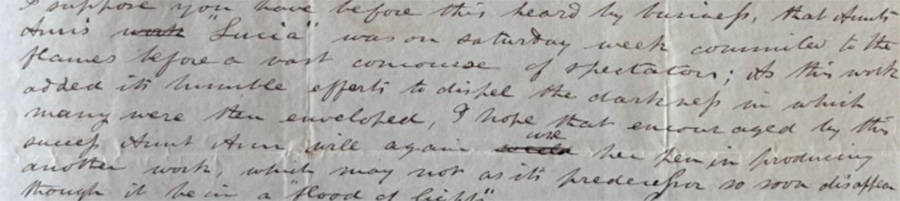
Another tribute and, most importantly, piece of evidence that the 1834 edition was indeed Ann Nicholas’ and not Andrew Norton’s translation, comes again from the Historic Hudson Valley’s collection. In a letter by Ann’s nephew Philip Rhinelander to his cousin Emma (Ann’s younger daughter) dated February 10, 1835, there is a references to the translation: “Aunt Ann’s ‘Lucia’ was on Saturday week committed to the flames before a vast concourse of spectators; As this work added its humble efforts to dispel the darkness in which many were then enveloped, I hope that encouraged by this success Aunt Ann will again use her pen in producing another work, which may not as it’s predecessor so soon disappear though it be in a ‘flood of light.’”

Ann deserved all the accolades. Her translation might have been flawed and incomplete but it was a significant undertaking, especially considering that she worked with Manzoni’s 1827 edition, before the author himself revised the novel over many years to make the language as close as possible to Florentine Tuscan. At that time, Italy was still divided into states and territories governed by different powers (Spain, France, the Austrian Empire, the Catholic Church), where people spoke a variety of dialects that were often mutually unintelligible. One of the accomplishments of Manzoni’s novel, in its final 1840 edition, was to help establish a literary language for the country that was eventually unified into a single nation in 1861.
Perhaps not surprisingly, Manzoni was not aware that his novel was being read across the Atlantic already in its earlier version. In 1839, when American novelist Catharine Maria Sedgwick visited the Italian writer in his Milan home, she reported that “Manzoni had not heard of the American translation of the Promessi Sposi, and he seemed gratified that his fame was extending over the New World.”9 America was not the only place where Ann’s translation was being read. It appears that it was even used for a British edition of the same year, entitled The Betrothed. From the Italian of Alessandro Manzoni, published in London by Richard Bentley.10 Since 1834, there have been other English translations of Manzoni’s novel on both sides of the Atlantic. In the United States, the last one (and first in fifty years) was published by The Modern Library in 2022, garnering excellent reviews for the ability with which translator Michael F. Moore succeeded in reproducing the spoken feel of Manzoni’s language. Thanks to his patient and skilled work, spanning several years, the story of Lucia continues to captivate English readers just like Ann’s translation did almost two centuries ago.
Manzoni’s novel tells a story that revolves around virtue and the power of faith. After learning about Ann’s life through my research fellowship at Historic Hudson Valley, I like to think that these values sustained her in later years, as she continued to forge her own path amidst personal and historical challenges. It’s been an honor to help bring to light the literary contributions of this remarkable New York woman with the help of librarian Catalina Hannan and researcher Kathryn Alexander. My hope is that Ann Hoffman Nicholas can now take her rightful place as one of the earliest American translators of a seminal work of Italian literature.
Roberta Garbarini-Philippe was a 2025 Women’s History Institute Margaretta (Happy) Rockefeller Summer Research Fellow. Ms. Garbarini-Philippe holds a BA in Translation (English and German) from the University of Bologna and an MA in Higher Education Administration and Student Affairs from New York University, Steinhardt School of Culture, Education, and Human Behavior. She is currently pursuing an MA in Museum Studies at CUNY School of Professional Studies. She has also published articles in the Daily Art Magazine and the Journal of Student Affairs at New York University.
Interested in learning more about our Women’s History Institute Summer Research Fellowship, including information on how to apply? Click here.