





19th Century Friendship Albums: More Than Just a Record of Memories
When my classmates and I signed our yearbooks, the most common entry was “HAGS!”—have a good summer! Even the most impersonal signature assumed a future. Once the good summer ended, you would see this person again.
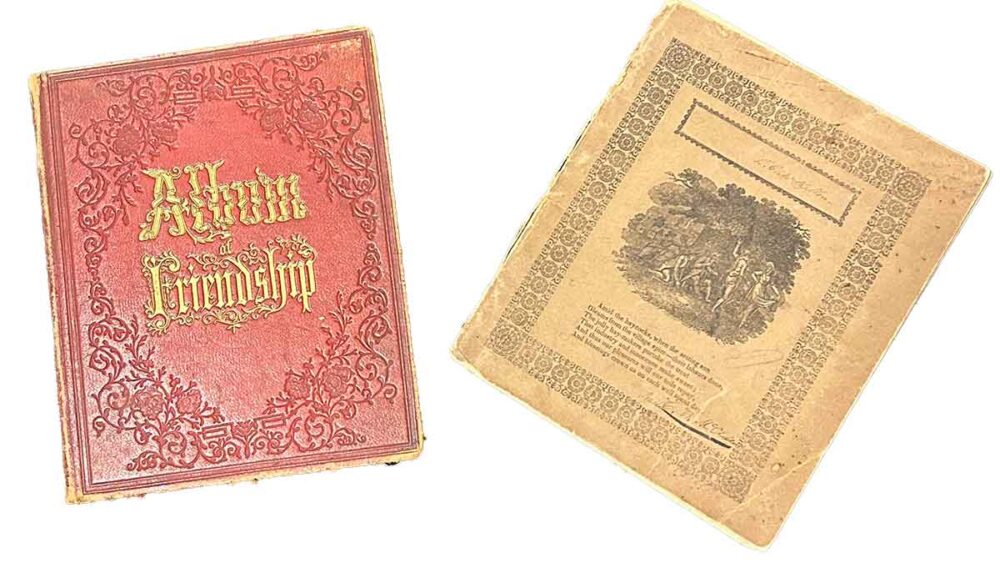
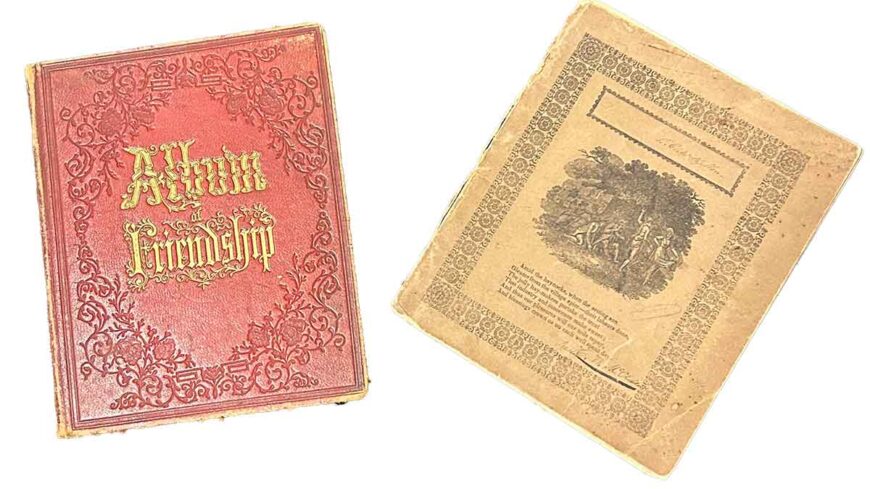
The friendship albums I have been transcribing this summer, kept by Matilda Averill and Emma Maloney in the mid-19th century, use the same basic occasion. A friend or a relative inscribes a page with a letter, a note, or a poem, meant to be kept and reread. However, its emotional register runs the opposite direction of what my generation grew up with. Consider an entry from Susan E. Whittlesy, written from Tallmadge, Ohio, in 1840:
“Friend after friend departs;
Who hath not lost a friend?
There is no union here of hearts
That finds not here an end;
Were this frail world our final rest
Loving or dying now were blessed.
Beyond the flight of time –
Beyond the reign of death –
There surely is some blessed [illegible]
Where life is not a breath;
Nor life’s affections, transient fire,
Whose sparks fly upwards and expire.
There is a world above,
Where parting is unknown;
A long eternity of love,
Formed for the good alone;
And faith behold, the dying have,
Translated to that glorious sphere.”
This sentiment of losing loved ones is not isolated to this poem. Matilda Averill’s album is dominated by one extended family of the Whittlesey cousins, aunts, uncles, and sisters who sign dozens of its pages. Their entries track the migration of their family. Early entries, from the late 1820s and 1830s, are signed from Salisbury, Connecticut. By 1840, entries began arriving from Canfield and Tallmadge, Ohio. These towns were part of the Connecticut Western Reserve, settled by families who had left Connecticut for the Ohio frontier during this time period. This album then becomes not simply a record of girlhood sentiment, but a document of a family scattering itself across a country, written by the young women who were left to deal with that separation.
Read this way, the bleakness of the album is the response to the pressure for young women in this time period that a friend or cousin who moved away might be gone for good. There was no expectation of a visit next summer, and the distance put between them was often permanent. The religious consolation that is engrained in almost every entry on this theme—“a world above, where parting is unknown”—was the only mechanism young girls had for absorbing a loss that had no other resolution.
Personal objects belonging to girls, such as letters, scrapbooks, and albums, have long been overlooked as important historic documents. These albums are evidence that young women used literature as responses to the material instability of female friendship networks during a period of active internal migration, religious revivalism, and high mortality rates. In 2026, the optimism of a yearbook assumes a stable, extended adolescence in which “see you soon” is a safe bet. In 1830, friendship, family, and geography were constantly at risk.
Zahra Virani was a 2026 Women’s History Institute Summer Research Fellow. She is a senior at Yale graduating in May 2026 with a B.A. in Urban Studies and the History of Art. She grew up in both Port Jervis, New York, and Houston, Texas. Her research explores the intersections of art, empire, and the built environment, with a particular interest in how cultural exchange shapes domestic space and identity. She is currently completing a senior thesis examining the impact of Islamic art on the homes of nineteenth-century artists, focusing on Frederic Edwin Church’s Olana and Frederic Leighton’s Leighton House.
Interested in learning more about our Women’s History Institute Summer Research Fellowship, including information on how to apply? Click here.